
Crab Hunter on a Narrow Shore: TheWhimbrel in Central Vietnam

The Whimbrel is not a threatened species, and the reasons it has stayed common
are the most useful thing it can teach. On a coast where the tide moves less than a
metre and the shoreline is being rebuilt, this crab-hunting curlew shows what a
migrant needs from every stretch of shore it uses, here and along a route that
runs from Siberia to Australia.
In April 2018, three Whimbrels fitted with satellite tags in eastern Australia set off north and flew an average of 7,121 kilometres before they first came down, a non-stop flight of about six days [1]. The fuel for a flight like that is laid down as fat before departure [1], and on the coast it is earned in the hours when the tide is out [2]. On the central coast of Vietnam, where Whimbrels have been photographed on the shore at Da Nang during the migration season [3], those hours come twice a day, as the sea falls back by half a metre to a metre [4].
The Whimbrel, Numenius phaeopus, is not threatened [5]. Its larger relative on the same flyway, the Far Eastern Curlew, is Endangered, a decline blamed mainly on the reclamation of its staging grounds in East Asia [6]. Researchers who tracked Whimbrels concluded that the loss of tidal flats at stopovers has had less impact on them,
because they can use many kinds of habitat [1]. Between those two findings sits the question this article follows: what does a flexible bird still need from a coast like this one?

• Globally Secure, Locally Little Known
The Whimbrel is easy to underrate because it is common. BirdLife International's 2024 assessment for the IUCN Red List keeps it at Least Concern, with an estimated 1.8 to 2.65 million mature individuals worldwide, but records the trend as decreasing, a judgement based largely on data from North America [5]. Which birds belong in that total depends on the checklist: AviList, the unified world checklist first published in June 2025, treats the American population as a separate species, the Hudsonian Whimbrel Numenius hudsonicus [7], while the BirdLife assessment still counts North American birds within Numenius phaeopus [5].
The birds that reach Vietnam belong to the East Asian–Australasian Flyway, where a 2016 revision of shorebird numbers put the Whimbrel population at 65,000 [8]. A global category built on two million birds can sit on top of a flyway population of tens of thousands. No flyway-wide trend for these birds was found in the sources reviewed.
65,000 - Whimbrels estimated for the whole East Asian–Australasian Flyway, against 1.8 to 2.65
Even the subspecies is less settled than expected. The one anticipated in East and Southeast Asia is N. p. variegatus, but of 30 birds tagged across the flyway, 21 bred within its range and six within that of rogachevae, a central Siberian subspecies that had been expected to winter in western India and East Africa; those six spent the
non-breeding season between northern Sumatra and north-western Australia [9]. No study found for this article identifies the subspecies on the central coast.
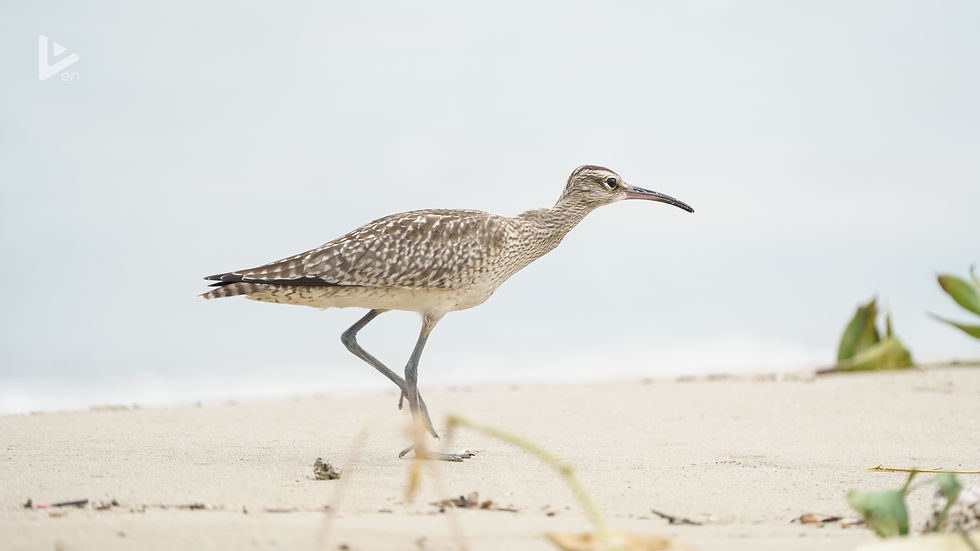
In the field it is a medium-sized curlew, 40 to 45 centimetres long, streaked brown above and white below, with two dark crown stripes, a long, slightly downcurved bill that is pink at the base of the lower mandible, a pale rump in flight and a far-carrying, rippling call [10]. Three relatives on the same flyway invite confusion: the Eurasian Curlew, Numenius arquata (choat mo cong lon), the Far Eastern Curlew, Numenius madagascariensis, and the Little Curlew, Numenius minutus [8] [10] [11]. Their bills differ markedly. A review of the genus put the two longest-billed species, one of them the Far Eastern Curlew, at 120 to 185 millimetres [12], while an average-sized Whimbrel probing for food pushes its bill up to 76 millimetres into the sediment if male and 84 if female [2]. In Vietnamese the Whimbrel is choat mo cong be, and it is not on the national list of endangered, precious and rare species prioritised for protection under Decree 64/2019, which names two sandpipers and no curlew [13].
When it is here is known mostly from birds followed elsewhere. Whimbrels leave the breeding grounds in July and reach northern Australia between August and October [10]; birds tracked from Australia completed the southward journey around 24 October and set off north again around 19 April [1]. No timetable for Vietnam itself was found, so
the calendar below shows the flyway pattern.

Whimbrels on this flyway spend only about two months on the breeding grounds. Bars show the mean departure and arrival dates of Whimbrels satellite-tracked from Australia in 2018 [1]; no Vietnam-specific timetable was found, so the bars show flyway timing rather than dates for this coast. The shaded band marks the September-to-December rainy season described for Quang Nam, which brings about 80 per cent of the year's rain; the same study gives August to November for the wider south-central region [4].
• Hunting Crabs by Sight in a Small Tidal Window
A Whimbrel feeds less like a prober than a hunter. In a study of variegatus on a bay in south-eastern Australia, crabs made up 93 per cent of the prey items in the birds' regurgitated pellets, and shrimps the rest [2]. The birds appeared to hunt by eye: most successful captures followed a run of half a metre to ten metres, two to three on
average, and most crabs were taken with a jab or probe after they had apparently retreated into shallow burrows. Bar-tailed Godwits on the same flats fed quite differently, probing rapidly for worms [2].
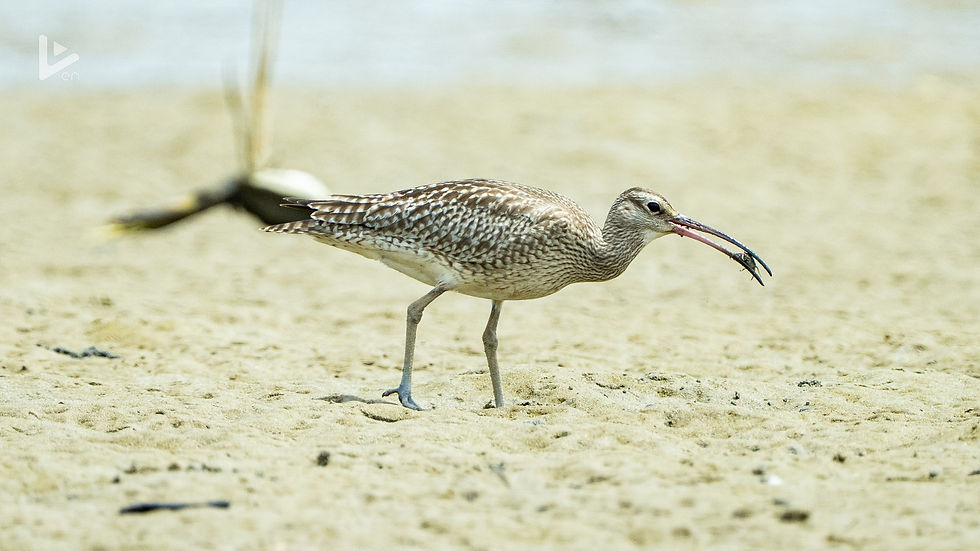
That is the work the bill does. Pecks at the surface never caught anything, while about one jab in eight and one probe in four was followed by the bird handling and swallowing prey [2]. A jab drove the bill in by up to half its length and a probe by up to its full length, and sometimes a bird simply probed into a crab burrow, twisting its head from side to side [2]. Across the curlews, longer bills go with feeding by touch in intertidal sediments and shorter bills with hunting by sight [12].
Hunting by sight ties the bird to the tide in a particular way. In the Australian study, Whimbrels preferred damp and drying mud above the water's edge, which the author linked to the difficulty of hunting by sight through water, and they fed for an average of four hours per tidal cycle [2]. Interruptions, disturbance among them, left about 70
per cent of that time for feeding, and the birds also fed at night at low tide [2] [10]. On the central coast of Vietnam the window is set by a small tide. A study of the Thu Bon estuary describes the tide on the Quang Nam coast as rising and falling twice a day through 0.5 to 1.0 metres, measured at the nearest gauge, at Da Nang, and notes that
monsoon conditions can hold sea level 30 to 40 centimetres higher for a week or more [4], a large addition to a tide this small.

A Whimbrel's day on the shore follows the tide: it feeds by sight on the exposed flat at low tide, is pushed up the shore as the water rises, and rests in a flock above the high-water line until the tide falls. Each stage brings its own disturbance, from people on the feeding flat to flushing at the roost, which forces costly flights [2][14]. Schematic cross-section drawn for this article, with the vertical scale strongly exaggerated; the 0.5 to 1.0 metre tide range is the figure given for the Quang Nam coast [4], and the feeding behaviour follows a study of the same subspecies in Australia.
When the water covers the flat, feeding stops and the birds must rest somewhere dry. Whimbrels roost in large flocks, often with other waders [10]. In the Australian study they gathered at the lower edge of the exposed shore and moved only when the water reached them [2], and flyway surveyors note that Whimbrels often roost in mangroves, where they are easily missed [8]. Because a resting flock is easily flushed, this article deliberately names no roost sites.
• More Than 11,000 Kilometres Each Way, and Every Stop Counts
The Whimbrel's migration is a chain of long flights joined by stops to refuel, and the stops take up most of the time. Ten Whimbrels tracked north from two Australian bays in 2018 covered an average of 11,609 kilometres in 41 days, almost 26 of them spent at stopovers; on the way south, eight birds took 90 days to cover 11,848 kilometres, about
three-quarters of that time on the ground [1].

Whimbrels on the central coast of Vietnam belong to the East Asian–Australasian Flyway, which links breeding grounds in Siberia with non-breeding coasts from Southeast Asia to Australia; birds tracked by satellite refuelled mainly in the Yellow Sea and along the coasts of China [1] [9]. The corridor is a schematic drawn for this article from those tracking studies, not a record of individual routes, and the central coast is marked as a general area with no sites shown. Coastlines from Natural Earth.
Those stops were concentrated in a few places. Northbound, the birds spent an average of about 12 days in the Yellow Sea, close to half of their stopover time [1], and Whimbrels that bred in the range of rogachevae stopped mainly along China's coasts [9].
7,121 km - average first non-stop flight north by three Whimbrels tagged in eastern Australia, lasting about six days [1]
Vietnam lies on the western edge of this system, between the Chinese coast and the non-breeding grounds further south. None of the tracking studies reviewed here tagged birds in Vietnam, so the routes of the Whimbrels on the central coast have not been measured; the few dozen tracked birds show the shape of the flyway, not the path of
any bird seen here [1] [9].
That shape explains why losing one stopover can matter more than losing a stretch of wintering coast. Birds from different wintering coasts converge on the same stops, as the Whimbrels tracked from two Australian bays did [1], so damage at a shared stop reaches all of them. Modelling for ten other migratory shorebirds on this flyway found
that sea-level rise would flood 23 to 40 per cent of the intertidal habitat along their routes, yet cut the network's capacity to carry birds through the migration, which the authors call population flow, by up to 72 per cent, because so much of the traffic passes through bottleneck sites [15].
• A Shoreline Being Rebuilt, From the Yellow Sea to Da Nang
The stopovers at the heart of this system have been shrinking for decades. Using satellite images and historical maps, a team led by Nicholas Murray found that tidal flats around the Yellow Sea covered about 1.12 million hectares in the 1950s, 544,812 hectares in the early 1980s and 389,303 hectares by the late 2000s: a loss of 28 per cent in roughly three decades, about 1.2 per cent a year, and of up to 65 per cent over five decades [16]. China lost 39.8 per cent of its Yellow Sea flats between the 1980s and the 2000s and South Korea 32.2 per cent, while North Korea's grew by 8.5 per cent; the authors traced the losses mainly to reclamation for cities, industry, farming and aquaculture [16].

Tidal flats around the Yellow Sea, a main refuelling region on the flyway, shrank from about 1.12 million hectares in the mid-1950s to 389,303 hectares by the late 2000s. The 1980s and 2000s figures come from Landsat satellite mapping and the 1950s figure from historical topographic maps, so the earliest bar is the least certain; all are minimum areas because 12.1 per cent of the coastline could not be mapped. Data cover about 4,000 kilometres of the coasts of China, North Korea and South Korea [16].
For birds that depend heavily on those flats, the consequences are measurable. Counts across Australia and New Zealand between 1993 and 2012 showed that shorebird taxa with more than half of their population staging in the Yellow Sea declined by an average of 5.2 per cent a year, while those with 40 per cent or less relying on it stayed
stable or declined only slightly; the Far Eastern Curlew was in the most dependent group [17].
5.2% - a year: average decline, 1993 to 2012, of shorebird taxa with more than half of their population staging in the Yellow Sea [17]
The Whimbrel was not part of that analysis, and its own record is mixed. In the tracking study, the north-western Australian population, the one more dependent on the Yellow Sea and the Chinese coast, had increased over past decades while the eastern population declined. That contrast underpins the authors' conclusion that stopover
losses have had less impact on Whimbrels, and they suggested that different levels of hunting on the breeding grounds might explain it [1]. Hunting is the least measured pressure of all. A 2020 review found shorebird hunting widespread across the flyway but unmonitored, with past harvests possibly reaching at least half of sustainable
limits [18]. In Da Nang, surveyors recording migratory birds between 2018 and 2020 reported bird snares and nets in several parts of the city and illegally trapped birds in pet shops, though the species were not named [19].
On the central coast itself, the change is to the shoreline. A Hue University study of the Thu Bon river mouth at Cua Dai over 50 years lists land reclamation, extraction of construction materials, mangrove clearance and upstream dams among the human causes of its shifting erosion and accretion [4]. In Da Nang, construction of a new
deep-water port began at the end of 2022, and in 2024 the prime minister endorsed land reclamation for a free-trade zone, with roughly 420 hectares earmarked for logistics [20]. North of Da Nang, the Tam Giang–Cau Hai lagoon system once held more than 20,000 migratory waterbirds in winter, according to reporting on the creation
of a wetland reserve there in 2020 [21].

Disturbance turns a smaller shore into a costlier one. On a tropical bay in north-western Australia, researchers studying knots, a different shorebird, found that the flights forced by disturbance at one favoured roost cost more energy than flying to the nearest alternative roost 25 kilometres away, and that more disturbance at that single
roost could make the feeding areas around it unusable without an energy deficit [14]. For a migrant, energy burned in escape flights is energy that does not become fat for the next long flight.
• A Chain of Sites, Protected One Link at a Time
Protection for migratory shorebirds is organised the way their journeys are: as a chain of sites. Vietnam joined the East Asian–Australasian Flyway Partnership in 2014, and its only Flyway Network Site is Tram Chim National Park, west of the main stream of the Mekong, listed as important for ducks and geese; no site on the central coast is in the
network [11]. On the central coast, protection has come through a provincial reserve. In 2020 the provincial government of Thua Thien Hue created the Tam Giang–Cau Hai wetland nature reserve, covering 2,071.5 hectares, 799.1 of them strictly protected, within a lagoon system whose water surface alone spans 216 square kilometres;
restoring wild bird populations is among its stated aims [21].
Elsewhere, the clearest action has been at the Yellow Sea itself. UNESCO inscribed the first phase of China's Migratory Bird Sanctuaries along the Coast of the Yellow Sea–Bohai Gulf as a World Heritage site in 2019 and approved a second phase in 2024, adding more than 100,000 hectares of migratory bird habitat [22]. The authors of
the Yellow Sea decline study named preventing further loss of tidal flats there as the most immediate priority, alongside managing artificial habitats such as salt pans, rice fields and seawalls for feeding and roosting shorebirds [17]. The 2016 population revision found large parts of Southeast Asia essentially unrepresented in shorebird counts [8].
The Whimbrel has stayed common by not specialising: it hunts crabs by sight on whatever shore the tide uncovers and rests wherever the water leaves it room. That flexibility has softened the losses that helped make the Far Eastern Curlew Endangered, but it has not freed the Whimbrel from the tide, the roost and the stopover. Each of
those is a stretch of shore that someone else also wants, on the central coast as much as on the Yellow Sea. The bird on the mud at low tide is a measure of how much of that shore is still left.
Sources
1. Kuang, F., Coleman, J.T., Hassell, C.J., Leung, K.-S.K., Maglio, G., Ke, W., Cheng, C., Zhao, J., Zhang, Z. and Ma, Z. (2020). Seasonal and population
differences in migration of Whimbrels in the East Asian–Australasian Flyway. Avian Research 11: 24. Springer Nature (open access).
https://sciopen.com/article/10.1186/s40657-020-00210-z (accessed 9 October 2026).
2. Dann, P. (1993). Abundance, diet and feeding behaviour of the Whimbrel Numenius phaeopus variegatus in Rhyll Inlet, Victoria. Corella 17(2): 52-57.
Australian Bird Study Association. https://absa.asn.au/wp-content/uploads/2021/08/Cor-Vol-17-Pg52-57_Behaviour_Whimbrel.pdf (accessed 9
October 2026).
3. Ho Xuan Mai (VietTimes) (2020). Chum anh: Nhung sieu mau duoc san don o Son Tra vao mua chim di cu (25 January 2020). VietTimes.
https://viettimes.vn/chum-anh-nhung-sieu-mau-duoc-san-don-o-son-tra-vao-mua-chim-di-cu-378968.html (accessed 9 October 2026).
4. Nguyen Quang Tuan, Hoang Cong Tin, Luong Quang Doc and Tran Anh Tuan (2017). Historical monitoring of shoreline changes in the Cua Dai estuary,
Central Vietnam, using multi-temporal remote sensing data. Geosciences 7(3): 72. MDPI. https://www.mdpi.com/2076-3263/7/3/72 (accessed 9
October 2026).
5. BirdLife International (2024). Species factsheet: Whimbrel Numenius phaeopus. IUCN Red List for birds (assessment 2024). BirdLife DataZone.
https://datazone.birdlife.org/species/factsheet/whimbrel-numenius-phaeopus (accessed 9 October 2026).
6. BirdLife International (2024). Species factsheet: Far Eastern Curlew Numenius madagascariensis. IUCN Red List for birds. BirdLife DataZone.
https://datazone.birdlife.org/species/factsheet/far-eastern-curlew-numenius-madagascariensis (accessed 9 October 2026).
7. Shersby, M. (Curlew Action) (2025). Global checklist deems Hudsonian Whimbrel as distinct species. Curlew Action.
https://www.curlewaction.org/hudsonian-whimbrel-reclassification-2/ (accessed 9 October 2026).
8. Hansen, B.D., Fuller, R.A., Watkins, D., Rogers, D.I., Clemens, R.S., Newman, M., Woehler, E.J. and Weller, D.R. (2016). Revision of the East
Asian–Australasian Flyway population estimates for 37 listed migratory shorebird species. Report for the Australian Department of the Environment.
BirdLife Australia. https://www.agriculture.gov.au/sites/default/files/documents/revision-east-asian-australasian-flyway-population-sept-2016.pdf
(accessed 9 October 2026).
9. Kuang, F., Wu, W., Li, D., Hassell, C.J., Maglio, G., Leung, K.-S.K., Coleman, J.T., Cheng, C., Tomkovich, P.S. and Ma, Z. (2022). Detecting the non-breeding
region and migration route of Whimbrels (Numenius phaeopus rogachevae) in the East Asian–Australasian Flyway. Avian Research 13: 100011. KeAi
(open access). https://doaj.org/article/210063275fed4abab15b16021747545f (accessed 9 October 2026).
10. Australian Museum (2023). Whimbrel (animal factsheet, updated 28 July 2023). Australian Museum, Sydney.
https://australian.museum/learn/animals/birds/whimbrel/ (accessed 9 October 2026).
11. East Asian–Australasian Flyway Partnership (undated). Socialist Republic of Vietnam: partner profile and Flyway Network Sites. EAAFP.
https://www.eaaflyway.net/?p=33196 (accessed 9 October 2026).
12. Dann, P. (2005). Is bill length in curlews Numenius associated with foraging habitats and diet in non-breeding grounds? Wader Study Group Bulletin
106: 60-61. International Wader Study Group. https://digitalcommons.usf.edu/wsg_bulletin/vol106/iss1/17 (accessed 9 October 2026).
13. Government of Viet Nam (2019). Decree 64/2019/ND-CP, Appendix I: list of endangered, precious and rare species prioritised for protection. Nature
and Biodiversity Conservation Agency (nbca.gov.vn). https://nbca.gov.vn/wp-content/uploads/2023/05/64_2019_ND-CP_418816.pdf (accessed 9
October 2026).
14. Rogers, D.I., Piersma, T. and Hassell, C.J. (2006). Roost availability may constrain shorebird distribution: exploring the energetic costs of roosting and
disturbance around a tropical bay. Biological Conservation 133: 225-235. Elsevier.
https://researchoutput.csu.edu.au/en/publications/roost-availability-may-constrain-shorebird-distribution-exploring/ (accessed 9 October 2026).
15. Iwamura, T., Possingham, H.P., Chades, I., Minton, C., Murray, N.J., Rogers, D.I., Treml, E.A. and Fuller, R.A. (2013). Migratory connectivity magnifies the
consequences of habitat loss from sea-level rise for shorebird populations. Proceedings of the Royal Society B 280: 20130325. The Royal Society.
https://researchonline.jcu.edu.au/60305 (accessed 9 October 2026).
16. Murray, N.J., Clemens, R.S., Phinn, S.R., Possingham, H.P. and Fuller, R.A. (2014). Tracking the rapid loss of tidal wetlands in the Yellow Sea. Frontiers in
Ecology and the Environment 12(5): 267-272. Ecological Society of America. https://researchonline.jcu.edu.au/60169/ (accessed 9 October 2026).
17. Studds, C.E., Kendall, B.E., Murray, N.J. and 14 others (2017). Rapid population decline in migratory shorebirds relying on Yellow Sea tidal mudflats as
stopover sites. Nature Communications 8: 14895. Springer Nature. https://www.nature.com/articles/ncomms14895 (accessed 9 October 2026).
18. Gallo-Cajiao, E., Morrison, T.H., Woodworth, B.K. and 13 others (2020). Extent and potential impact of hunting on migratory shorebirds in the
Asia-Pacific. Biological Conservation 246: 108582. Elsevier. https://researchonline.jcu.edu.au/63497/ (accessed 9 October 2026).
19. Viet Nam News (2020). Endangered migratory bird species found in Da Nang (10 December 2020). Viet Nam News Agency.
https://vietnamnews.vn/society/825264/endangered-migratory-bird-species-found-in-da-nang.html (accessed 9 October 2026).
20. Doan Nhan and Nguyen Thu (Tuoi Tre News) (2024). Prime minister endorses land reclamation for free trade zone in Da Nang (3 September 2024). Tuoi
Tre News. https://news.tuoitre.vn/prime-minister-endorses-land-reclamation-for-free-trade-zone-in-da-nang-10381770.htm (accessed 9 October
2026).
21. Van Dinh (Bao Nong nghiep va Moi truong) (2020). Thanh lap Khu bao ton thien nhien dat ngap nuoc Tam Giang - Cau Hai. Bao Nong nghiep va Moi
truong. https://nongnghiepmoitruong.vn/thanh-lap-khu-bao-ton-thien-nhien-dat-ngap-nuoc-tam-giang-cau-hai-d660169.html (accessed 9 October
2026).
22. UNESCO World Heritage Committee (2024). Decision: Migratory Bird Sanctuaries along the Coast of Yellow Sea–Bohai Gulf of China (extension, Phase
II). UNESCO World Heritage Centre. https://whc.unesco.org/en/decisions/8595 (accessed 9 October 2026).
Comments