
A Fish Disguised as Part of the Reef, on aCoast That Is Losing Its Reefs

Scorpionfish spend their lives motionless on the reefs of Da Nang, so well camouflaged that a foot can find them before an eye does. The reefs that hide them are shrinking, and the one scorpionfish Vietnamese law protects shares its name with a stonefish sold as a delicacy.
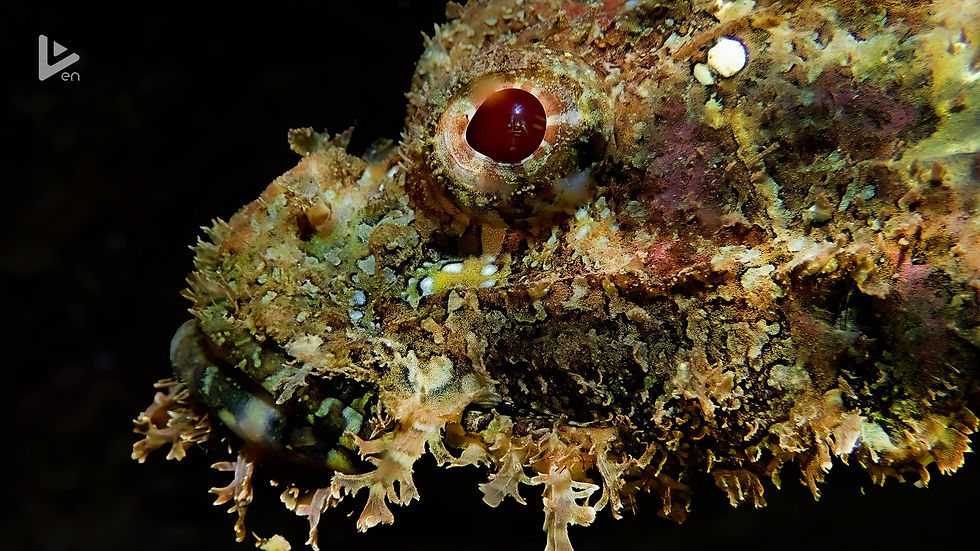
A scorpionfish hunts by keeping still. It settles on a rock and waits until a small fish or crustacean comes close enough to be caught in a sudden suck of the mouth [1],[2]. Its defence works the same way. Along its back runs a row of a dozen or so spines, with venom tissue lying in grooves down their sides and no muscle to drive it out; the venom moves only when something presses on a spine [3],[4]. On the Da Nang coast the fish
lives on reefs that are shrinking: those around the Son Tra peninsula lost 42 per cent of their area in a single decade [5].

The Cu Lao Cham islands, off the same coast, have had scorpionfish on their species lists for at least twenty years [6]. No study retrieved has counted them.
• One family, and one name for two fish
Scorpionfish are a family rather than a fish. Eschmeyer's Catalog of Fishes recognised 388 valid species of Scorpaenidae in October 2026, the lionfishes among them, while the stonefishes, the most dangerous relatives, are classed separately as Synanceiidae [7]. FishBase lists 38 scorpaenid species as present in Vietnamese waters [8] and
records nine of them from Cu Lao Cham, among them the tasselled scorpionfish Scorpaenopsis oxycephala and the devil scorpionfish Scorpaenopsis diabolus [6]. Both, like the red and zebra lionfishes, are listed as Least Concern on the IUCN Red List [9],[10],[11],[12]. Those global assessments, made in 2015, cannot show what is happening on one stretch of reef, and on this coast there is no count that could.
38 species - of scorpionfish listed for Vietnamese waters, nine of them recorded at Cu Lao Cham
Tracing the fish through Vietnamese sources is complicated by its names. The family is ho ca mu lan [13], and a 2013 VnExpress travel feature on diving at Son Tra uses ca bo cap for the scorpionfish living in rock crevices there [14]. The name that matters most is ca mat quy. In markets and the press it means stonefishes of the genus Synanceia [15], and FishBase gives it to the reef stonefish [8]. In Vietnam's national list of endangered, precious and rare aquatic species it means the devil scorpionfish, the only member of the family the list protects [16].

Reef scorpionfish need hard ground, which on the Da Nang coast lies mainly in the reef fringe of the Son Tra peninsula, along the rocky shore below the Hai Van pass, including the rock reef at Nam O, and around the Cu Lao Cham islands. A 2020 to 2022 survey also recorded scorpionfish just north of the pass. Zones are deliberately coarse.
What the fish needs from the coast is hard, complex ground: the tasselled scorpionfish lives alone on coral and rocky bottoms from 1 to at least 35 metres [9]. Ground of that kind is scarce here. Around the Son Tra peninsula the reefs form a narrow fringe from the intertidal zone to about 10 metres [5]. The rocky shore below the Hai Van pass has
patches of coral reef on the Da Nang side, and just north of the pass a 2020 to 2022 survey of the North Hai Van and Son Cha coast recorded four scorpaenid species [17]; at Nam O a rock reef about 500 metres long juts into the bay [18]. The islands of Cu Lao Cham carry about 356 hectares of reef [19], more than seven times the 46.9 hectares mapped around Son Tra in 2016 [5].
• Built to be overlooked
The disguise has several layers. Many scorpionfishes carry skin flaps, or cirri, on the head, especially above the eye [2], and adult tasselled scorpionfish are so fringed with tassels that they are described as bearded [9]. Colour is adjusted on the spot. In experiments in Corsica, two Mediterranean species changed both brightness and hue when moved to a new background, with about half of the brightness change seen after one minute completed within five to ten seconds [1].

All of this serves one way of feeding. Scorpionfishes are sit-and-wait predators that stay motionless until prey, mostly small fishes and invertebrates, is close enough to be caught by suction [1]. What a scorpaenid predator can do is shown by the lionfish invasion of the Atlantic: on patch reefs in the Bahamas, a single lionfish on each reef cut the recruitment of native fishes by an average of 79 per cent over five weeks [20]. In its native Indo-Pacific range, which includes Vietnam, the same kind of animal lives at far lower densities [21],[11].
The same disguise hides the fish from the people counting it. General underwater surveys detect only about one in eight Indo-Pacific lionfish, because observers do not search intensively in the holes, crevices and ledges where lionfish tend to hide by day [21]. Cu Lao Cham may illustrate the effect. FishBase, drawing on a national study of reef
fishes from the mid-2000s, lists nine scorpaenid species there [6]. The 2016 survey of the biosphere reserve, which combined visual census with fishing-gear samples and species lists from other studies to reach 356 fish species, lists two, both lionfishes [22].
1 in 8 - Indo-Pacific lionfish detected by general reef fish surveys
• A defence that waits to be stepped on
The venom apparatus is simple. In the spotted scorpionfish Scorpaena plumieri, 12 dorsal, 2 pelvic and 3 anal spines carry venom, each wrapped in a sheath of skin, and the venom gland is not a well-defined organ but a group of secretory cells lying in grooves along the spine [3]. No muscle is attached, so the fish cannot release venom at will; it is forced out only when pressure on a spine tears the sheath [4],[3]. The weapon is defensive in the strictest sense. It does nothing until the fish is grabbed or trodden on.
How much a sting hurts depends on the fish. Lionfish, with long slender spines and small venom glands, have the mildest sting; true scorpionfish, with shorter, thicker spines and larger glands, a more dangerous one; and stonefish a potentially deadly one [23]. A scorpionfish sting typically brings immediate burning pain that peaks 30 to 90
minutes later, and any wider symptoms generally pass within 24 to 48 hours [24].
The first aid that works is heat. Current advice is to soak the wound in water as hot as can be tolerated, but no hotter than 45 degrees, for 30 to 90 minutes, with someone else testing the temperature [25]. In the laboratory, 20 minutes at 42 degrees detoxified the venom of the estuarine stonefish, Synanceia horrida [26], though the clinical evidence rests on case series rather than controlled trials [27]. Advice published in Vietnam does not always agree. A 2020 article in the navy newspaper recommended a tourniquet and water at 40 to 50 degrees for lionfish stings [28], although water near 50 degrees risks burns [26].

A scorpionfish's venom sits in the spines of three fins: the dorsal fin along the back, the pelvic fins beneath the chest and the anal fin under the tail. With no muscle to inject it, venom enters a wound only when a spine is pressed into skin.
How often stings happen in Vietnam is unknown. The only recent medical case found was a fisherman stung in the foot by a lionfish (ca mao tien) near Truong Sa in March 2025 [29]; no published sting record from Da Nang was found. Vietnam's national register of medicines lists no stonefish antivenom, only two snake antivenoms made in
Nha Trang, although it does not record special imports [30].
• Reefs that are losing their hiding places
The best measured loss is on the Son Tra peninsula. When the Institute of Oceanography surveyed its reefs in 2016, reef area had fallen to about 46.9 hectares from 80.9 hectares reported in 2006, a loss of 42 per cent [5]. Hard coral cover at Bai Bac fell from 31.9 to 0.6 per cent, at Mui Lo from 21.3 to 7.5 per cent and at Huc Lo from 31.25 to 4.7 per cent, while four other sites gained a little hard coral [5]. The institute named coastal infrastructure and urban development, sedimentation and overfishing as the main causes [5].
42% - of the Son Tra peninsula's reef area lost between 2006 and 2016

Between 2006 and 2016 the Son Tra peninsula lost 42 per cent of its reef area, and hard coral almost disappeared from some sites while rising a little at others. All values are from the Institute of Oceanography survey of 2016 [5]; the 2006 values are as reported in that survey.
The pressures continue. Threats recorded at Son Tra include trampling by tourists, ghost nets and litter on the seabed, and wastewater and oil from boats [31]. In March 2018 a photographer taking pictures of langurs on the peninsula heard two explosions in the bay below and watched a crew collect stunned fish for more than an hour [32].
For an ambush predator, what matters is the framework. A meta-analysis of 17 studies found that 62 per cent of reef fish species declined within three years of disturbances that removed more than a tenth of coral cover, and that disturbances which destroy the framework outright hit fishes harder than coral deaths that leave it standing, most
of all among small species [33]. A scorpionfish needs a ledge to sit on, a crevice to back into and a supply of small fish that need the same reef. When the reef flattens, all three go at once.
Cu Lao Cham, the best-protected reef on the coast, is not in good condition either. At ten stations in June 2016, live coral cover averaged 24.8 per cent, of which hard coral was only 11.6 per cent, and predatory fish averaged 1.9 per 100 square metres [34]. Tourism adds to the pressure. In 2019 the islands received 2,500 to 6,000 visitors a day, up to twice the 3,000 considered their capacity [35].
• What protection exists, and what it actually covers
On paper, fishing with explosives, poisons and electric current is already banned by Vietnam's Law on Fisheries [36]. Only one scorpionfish is protected in its own right. The devil scorpionfish, listed as ca mat quy, is in Group I of the national list of endangered, precious and rare aquatic species, the category in which catching is strictly banned
except for conservation, research and a few other approved purposes [37],[16]. It has been on the list since 2019 [38], when the test for Group I was a species' value combined with severe scarcity in the wild, measured as a population decline of at least 50 per cent within five years [39]. Globally it is rated Least Concern [10], and no published population data for it in Vietnam was found.
The name is where the difficulty lies. A fish sold as ca mat quy, which the press says is also called ca da (stone fish), sells for 800,000 to 1.6 million VND per kilogram and is caught by divers on reefs near islands such as Ly Son, Con Dao and Phu Quy [40]. A fish sold under that name could therefore be a stonefish that may legally be caught or a
scorpionfish that may not, and the menu will not say which.
Group I - the stricter of Vietnam's two protection categories for aquatic species, held by a single scorpionfish

On a narrow fringing reef such as Son Tra's, scorpionfish sit on rock, coral and rubble from the shallows to the foot of the slope, and the same strip is pressed from the sea and from the shore. Schematic, vertical scale exaggerated.
Cu Lao Cham, a nature reserve of 23,530 hectares including its buffer zone [41], is the only reef on this coast inside a formal protected area. Under the regulation Da Nang issued in May 2026, its strictly protected zone covers 566.81 hectares, about 2.4 per cent of that total, and tourist vessels may not anchor on coral reefs or seagrass [42]. The Son Tra peninsula has no marine protected area, only five coral protection sites that its management board marks with buoys [31],[43]. The national fisheries plan approved in May 2024 provides for a 4,450-hectare reserve there, to be set up between 2025 and 2030 [44]; no report retrieved, the latest from August 2026, says it has been established [45],[43].
For a fish this hard to see, the first gap is knowledge, and it is cheap to close. A crevice search for scorpionfish added
to existing reef surveys at Son Tra and Cu Lao Cham would produce the first counts, and the method matters,
because general surveys are estimated to detect only about one in eight lionfish, close relatives in the same family [21]
.
Photographs from divers would help too: iNaturalist held only 13 scorpionfish observations from this coast in October 2026, five of them research grade [46]. Two further measures need no diving at all: first-aid advice for fishers and divers that matches the medical evidence, and help for buyers and restaurants in telling a stonefish from a protected devil scorpionfish. One note on this article itself: it maps reef areas only coarsely and names no site where scorpionfish can reliably be found, because the devil scorpionfish is protected by law.
The scorpionfish is not rare, and nothing in the global record suggests that it is in trouble. It is a common predator doing what it has always done, sitting still and trusting its disguise, on a coast where the reef it is disguised as is being worn away. What happens on the reefs of Son Tra and Cu Lao Cham will not move it a category on any global list. It will decide whether there is still a reef on this coast for it to pass for, and that is a question that can only be answered here.
Sources
Numbered markers in the text link each claim to the source below. Every source listed was opened during research; for a few journal
articles only the abstract was accessible. Date accessed for all sources: 23 October 2026.
1. John, L., Santon, M. and Michiels, N. K. 2023. Scorpionfish rapidly change colour in response to their background. Frontiers in Zoology 20: 10.
2. Poss, S. G. 1999. Scorpaenidae: scorpionfishes (also lionfishes, rockfishes, stingfishes, stonefishes and waspfishes). In Carpenter, K. E. and Niem, V. H. (eds), FAO
species identification guide for fishery purposes: the living marine resources of the Western Central Pacific, Vol. 4: 2291-2352. FAO, Rome.
3. Campos, F. V., Menezes, T. N., Malacarne, P. F., Costa, F. L. S., Naumann, G. B., Gomes, H. L. and Figueiredo, S. G. 2016. A review on the Scorpaena plumieri fish
venom and its bioactive compounds. Journal of Venomous Animals and Toxins including Tropical Diseases 22: 35. https://pmc.ncbi.nlm.nih.gov/articles/PMC5175314
4. Ziegman, R. and Alewood, P. 2015. Bioactive components in fish venoms. Toxins 7(5): 1497-1531. https://www.ncbi.nlm.nih.gov/pmc/articles/PMC4448160/
5. Nguyen Xuan Hoa (Institute of Oceanography, Nha Trang). 2017. Hien trang da dang sinh hoc o vung bien ven bo ban dao Son Tra (Status of biodiversity in the
coastal waters of the Son Tra peninsula), workshop presentation, 21 July 2017. PanNature.
6. Froese, R. and Pauly, D. (eds). (no date given). Viet Nam country records for Scorpaenidae citing Nguyen Nhat Thi and Nguyen Van Quan, Biodiversity and living
resources of the coral reef fishes in Vietnam marine waters, Science and Technology Publishing House, Hanoi (FishBase Ref. 58534, dated 2006 in FishBase):
species list for the reference. FishBase. https://www.fishbase.se/References/SpeciesUsedRefList.php?refno=58534
7. Fricke, R. and Fong, J. D. 2026. Genera and species by family and subfamily, online version updated 20 October 2026. Eschmeyer's Catalog of Fishes, California
Academy of Sciences. https://researcharchive.calacademy.org/research/ichthyology/catalog/SpeciesByFamily.asp
8. Froese, R. and Pauly, D. (eds). (no date given). All fishes reported from Viet Nam: country checklist and Vietnamese common names. FishBase.
9. Froese, R. and Pauly, D. (eds). (no date given). Scorpaenopsis oxycephala, Tassled scorpionfish: species summary. FishBase.
10. Froese, R. and Pauly, D. (eds). (no date given). Scorpaenopsis diabolus, False stonefish: species summary. FishBase.
11. Froese, R. and Pauly, D. (eds). (no date given). Pterois volitans, Red lionfish: species summary and country list. FishBase.
12. Froese, R. and Pauly, D. (eds). (no date given). Dendrochirus zebra, Zebra turkeyfish: species summary. FishBase.
13. Wikipedia contributors. 2024. Ho Ca mu lan (Scorpaenidae), last revised 11 March 2024. Wikipedia tieng Viet.
14. Phuong Thao. 2013. Su song trong long bien Son Tra (Life beneath the sea at Son Tra), 5 June 2013. VnExpress.
15. VietNamNet, from Dan Viet. 2016. Ca mat quy: dac san nhin phat ghe, an lai me (Stonefish: a delicacy that looks frightening and tastes delicious), 13 May
16. Ministry of Agriculture and Environment, Viet Nam. 2025. Phu luc III: Danh muc loai thuy san nguy cap, quy, hiem (Appendix III: list of endangered, precious
and rare aquatic species), issued with Circular 88/2025/TT-BNNMT, signed 31 December 2025. Government e-portal.
17. Le Nguyen Thoi Trung, Vo Dieu and Nguyen Ngoc Hoa. 2023. Thanh phan loai ca ran san ho vung bien ven bo Bac Hai Van - Son Cha, tinh Thua Thien Hue
(Species composition of coral reef fishes in the coastal waters of North Hai Van - Son Cha, Thua Thien Hue province). Quy Nhon University Journal of Science
18. Vietnam News Agency, published by VietnamPlus. 2021. Nam O Reef, the green pearl of Da Nang, 28 February 2021. VietnamPlus.
19. K. Chi. 2026. Quan trac ran san ho tai Cu Lao Cham (Monitoring the coral reefs of Cu Lao Cham), 16 May 2026. Bao Van Hoa.
20. Albins, M. A. and Hixon, M. A. 2008. Invasive Indo-Pacific lionfish Pterois volitans reduce recruitment of Atlantic coral-reef fishes. Marine Ecology Progress
Series 367: 233-238. https://www.int-res.com/abstracts/meps/v367/p233-238/
21. Kulbicki, M. and colleagues. 2012. Distributions of Indo-Pacific lionfishes Pterois spp. in their native ranges: implications for the Atlantic invasion. Marine
Ecology Progress Series 446: 189-205. https://archimer.ifremer.fr/doc/00207/31781/30193.pdf
22. Nguyen Van Long and Mai Xuan Dat. 2020. Characteristics of fish fauna in marine ecosystems in the World Biosphere Reserve of Cu Lao Cham - Hoi An.
Vietnam Journal of Marine Science and Technology 20(1): 105-120. https://vjs.ac.vn/index.php/jmst/article/download/13553/383619/397222
23. Elston, D. M. 2006. Aquatic antagonists: lionfish (Pterois volitans). Cutis 77(4): 215-216.
24. Afvari, S. and Elston, D. M. 2024. Aquatic antagonists: scorpionfish envenomation. Cutis 113(3): 133-136.
25. Gomez Castillo, J. D. 2018. Lionfish stings. Alert Diver, Q3 2018, Divers Alert Network. https://dan.org/?p=13041
26. Barnett, S., Saggiomo, S., Smout, M. and Seymour, J. 2017. Heat deactivation of the stonefish Synanceia horrida venom: implications for first-aid
management. Diving and Hyperbaric Medicine 47(3): 155-158. https://pmc.ncbi.nlm.nih.gov/articles/PMC6159625
27. Atkinson, P. R. T., Boyle, A., Hartin, D. and McAuley, D. 2006. Is hot water immersion an effective treatment for marine envenomation? Emergency Medicine
Journal 23(7): 503-508. https://pmc.ncbi.nlm.nih.gov/articles/PMC2579537/
28. Xuan Huong. 2020. Mot so loai dong vat bien doc gay tu vong nhanh co o bien Viet Nam (Some venomous marine animals in Vietnamese waters that can kill
quickly), 1 August 2020. Bao Hai quan Viet Nam. https://baohaiquanvietnam.vn/tin-tuc/mot-so-loai-dong-vat-bien-doc-gay-tu-vong-nhanh-co-o-bien-viet-nam
29. Voice of Vietnam. 2025. Benh xa dao Truong Sa cap cuu ngu dan bi ca mao tien dam vao chan (Truong Sa island infirmary treats a fisherman stung in the foot
by a lionfish), 10 March 2025. VOV. https://vov.vn/xa-hoi/benh-xa-dao-truong-sa-cap-cuu-ngu-dan-bi-ca-mao-tien-dam-vao-chan-post1160166.vov
30. Drug Administration of Vietnam, Ministry of Health. 2026. Cong bo giay dang ky thuoc, nguyen lieu lam thuoc tai Viet Nam (public register of medicines
registered in Viet Nam), searched 23 October 2026. Cong dich vu cong truc tuyen. https://dichvucong.dav.gov.vn/congbothuoc/index
31. Ngoc Ha. 2021. Bao ve ran san ho tu nhien tai ban dao Son Tra (Protecting the natural coral reefs of the Son Tra peninsula), 26 May 2021. Bao Van Hoa.
32. Tan Viet. 2018. Dung thuoc no danh ca ngay trong vinh Da Nang? (Fishing with explosives right inside Da Nang Bay?), 31 March 2018. Phap Luat TP.HCM.
33. Wilson, S. K., Graham, N. A. J., Pratchett, M. S., Jones, G. P. and Polunin, N. V. C. 2006. Multiple disturbances and the global degradation of coral reefs: are reef
fishes at risk or resilient? Global Change Biology 12(11): 2220-2234. https://doi.org/10.1111/j.1365-2486.2006.01252.x
34. Nguyen Van Long, Vo Si Tuan and Nguyen Van Vu. 2021. Species diversity and status of key marine habitats in Cu Lao Cham Marine Protected Area, Quang
Nam province. Vietnam Journal of Marine Science and Technology 21(2): 201-213. https://vjs.ac.vn/index.php/jmst/article/download/15078/384867/410277
35. Tuoi Tre News. 2019. Vietnamese localities in dispute over tourist volumes to Cham Islands, 3 May 2019. Tuoi Tre News.
36. National Assembly of Viet Nam. 2017. Law No. 18/2017/QH14 on Fisheries, 21 November 2017, English translation. LuatVietnam.
37. Ministry of Agriculture and Environment, Viet Nam. 2025. Thong tu 88/2025/TT-BNNMT huong dan ve bao ve va phat trien nguon loi thuy san (Circular
88/2025 on the protection and development of aquatic resources). LuatVietnam.
38. Government of Viet Nam, reproduced by Hoatieu.vn. 2019. Danh muc loai thuy san nguy cap, quy, hiem (list of endangered, precious and rare aquatic
species), Appendix II of Decree 26/2019/ND-CP. Hoatieu.vn. https://hoatieu.vn/bieu-mau/danh-muc-loai-thuy-san-nguy-cap-quy-hiem-167277
39. Government of Viet Nam. 2019. Nghi dinh 26/2019/ND-CP quy dinh chi tiet mot so dieu va bien phap thi hanh Luat Thuy san (Decree 26/2019 detailing the
Law on Fisheries), Article 7, 8 March 2019. caselaw.vn.
40. Thao Trinh, from VietNamNet. 2024. Loai ca nhin xau ton, khach Ha Noi van chi nua chi vang tim mua (A fierce-looking fish that Hanoi buyers still pay half a chi
of gold for), 5 October 2024. Nguoi Quan Sat. https://nguoiquansat.vn/loai-ca-nhin-xau-ton-khach-ha-noi-van-chi-nua-chi-vang-tim-mua-164191.html
41. Tan Thanh and Chi Dai. 2025. Quang Nam: Thanh lap Khu bao ton thien nhien Cu Lao Cham (Quang Nam establishes the Cu Lao Cham Nature Reserve), 4
March 2025. Bao Dai Doan Ket. https://daidoanket.vn/quang-nam-thanh-lap-khu-bao-ton-thien-nhien-cu-lao-cham-10300882.html
42. Da Nang City People's Committee. 2026. Quy che quan ly Khu bao ton Thien nhien Cu Lao Cham (management regulation of the Cu Lao Cham Nature Reserve),
issued with Decision 63/2026/QD-UBND, 28 May 2026. Cu Lao Cham Nature Reserve Management Board.
43. Hoai Thu. 2026. Da Nang don suc bao ve he sinh thai bien o Cu Lao Cham va ban dao Son Tra (Da Nang steps up protection of marine ecosystems at Cu Lao
Cham and the Son Tra peninsula), 22 August 2026. Bao Cong an Nhan dan.
44. Prime Minister of Viet Nam. 2024. Quyet dinh 389/QD-TTg phe duyet Quy hoach bao ve va khai thac nguon loi thuy san thoi ky 2021-2030, tam nhin den nam
2050 (Decision 389/QD-TTg approving the national plan for the protection and exploitation of fisheries resources, 2021-2030), 9 May 2024, Appendices I, III and
VII. Government e-portal. https://datafiles.chinhphu.vn/cpp/files/vbpq/2024/5/389-ttg.signed.pdf
45. Lan Anh. (no date given). Da Nang: Giu mai nha chung cho sinh vat bien (Da Nang: keeping a common roof over marine life). Bao Nong nghiep va Moi truong.
46. iNaturalist. 2026. Observations of Scorpaenidae (taxon 47285) in the Da Nang place (pre-2025 city boundary) and the Quang Nam place (which holds the Cu
Lao Cham records), queried 23 October 2026. California Academy of Sciences and National Geographic Society.
Comments